 StoryCodex
Track 1,000+ Chapter Web Novels Without Spoilers
A spoiler-safe system for tracking characters, factions, and plot threads across 1,000+ chapter web novels without risky fan wiki visits.
 ForgeAppsUpdated September 19, 20268 min read
Serials on Royal Road, Wuxiaworld, and Webnovel routinely pass one or two thousand chapters. By chapter 500 you may be tracking a hundred named characters, a dozen factions, and a power system with its own rank ladder. When a side character resurfaces after 300 chapters, the natural move is opening a fan wiki, and the natural result is a sentence that spoils a death fifty chapters ahead of your bookmark.
Why fan wikis fail active readers
Community wikis are written backwards from the latest chapter. A character's infobox lists their current status, true identity, and final allegiance, which is exactly what you must not see at chapter 400. The wiki has no idea where you stopped, so every search is a gamble. A spoiler-safe Story Codex takes the opposite approach: it is built only from chapters you have finished, so nothing it shows you can leak the future.
Bounded is the key word. A Codex entry is not 'everything the fandom knows about this person.' It is a summary of what the story has revealed about them up to your chapter, plus the moments where they appeared. If a mentor is secretly the villain and the reveal lands in chapter 900, your chapter-400 profile still says 'helpful mentor,' because that is the truth as of where you are standing. That is the difference between a memory aid and a spoiler machine.
The web serial memory trap
Wiki Spoilers
Fandom wikis put character status, secret identities, and late-story twists right at the top of the article, before any spoiler warning can help.
Alias Confusion
Cultivators and fantasy nobles collect titles, courtesy names, and translated epithets across arcs, so one person can look like three strangers.
Coming Back Cold
Even a few weeks away from a daily serial erases the minor details that make resuming easy. Our guide to catching up after a hiatus covers that workflow in depth.
Fragmented Reading
Bouncing between browser tabs, Discord threads, and raw pages breaks focus, and every detour is another chance to see something you should not.
A worked example: the Senior Brother Meng problem
Picture a real reading moment. You are 400 chapters into a cultivation serial. Back in chapter 80, a 'Senior Brother Meng' handed the protagonist a jade token and disappeared. Now, in chapter 412, a 'Meng Zhou, Elder of the Outer Council' walks onstage, and the protagonist clearly recognizes him. Is this the same person? A wiki search answers the question in one line and then ruins the next five hundred chapters by telling you he dies betraying the sect. Inside StoryCodex, the name is already underlined in the chapter text. You tap it, and the lookup card shows what the story itself has proven so far: his first appearance, the jade token, and the chapters where he has surfaced since. The answer costs two seconds and zero spoilers.
That lookup card is deliberately small. It leads with the character's recent chapter-by-chapter changes, with anything from the chapter you are reading pinned first, then the people who share the current scene, then a door into the full profile. Every entry is lensed to your position: a change logged in chapter 600 simply does not exist on the card while you are reading chapter 412. The full Codex profile sits one tap away through 'Open full Codex' if you want the complete bounded history rather than the quick reminder.
The 4-step spoiler-safe tracking system
How to read mega-serials with complete confidence
- 1
1. Read with a bounded local Codex
Instead of searching online, use a reader that builds a private wiki bounded strictly by your finished chapters. StoryCodex indexes characters, places, and factions only up to your exact reading position.
- 2
2. Tap inline lore marks mid-sentence
When an obscure name or title appears in the chapter text, tap the highlighted term to pull up its lore card without leaving the reader or risking future events.
- 3
3. Keep one continuous story memory
Arcs and volumes of the same serial should share a single Codex, so aliases merge and relationships evolve instead of restarting with every new part.
- 4
4. Trigger a recap before each new arc
Before diving into a 200-chapter arc, generate a spoiler-gated Previously On recap of the milestones so far, and start the arc with fresh context.
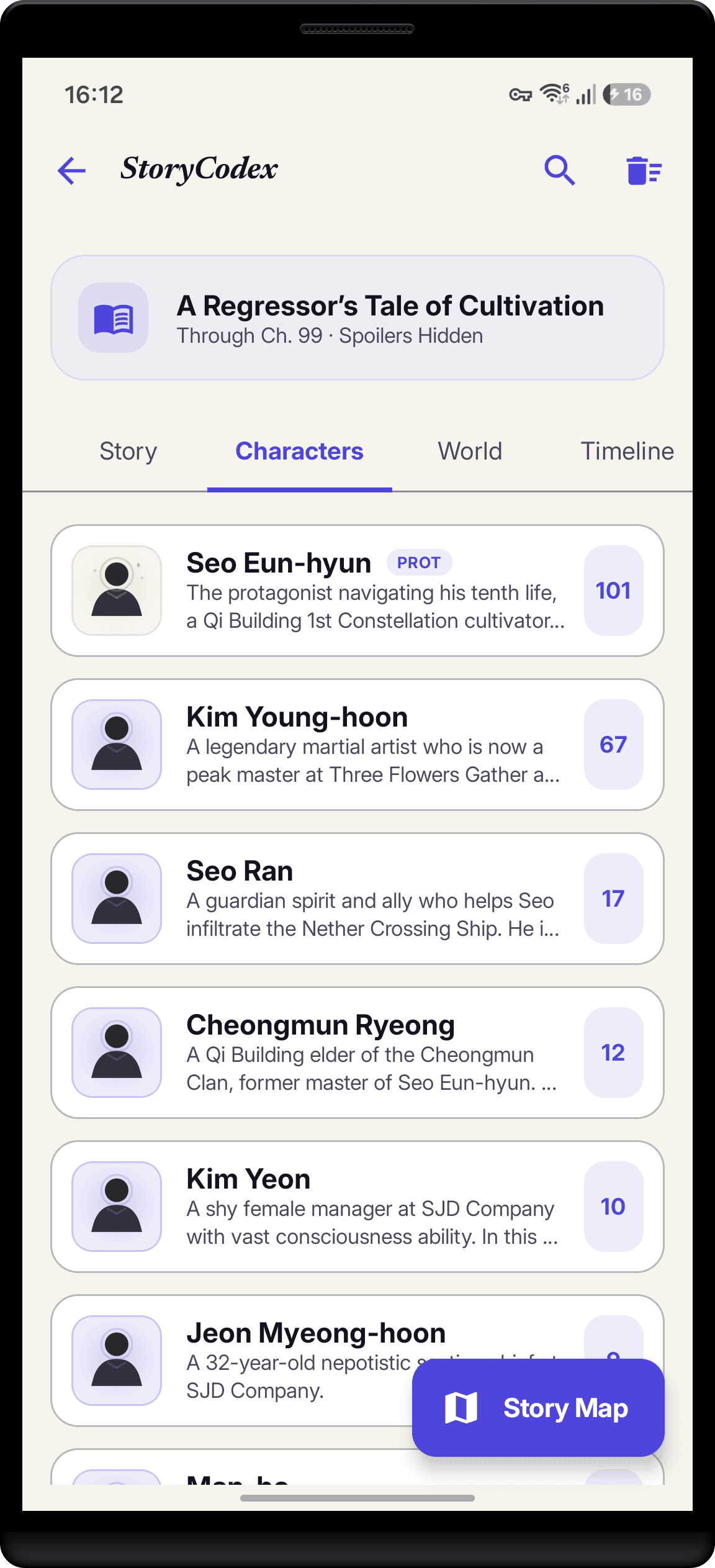
How the Codex knows two names are one person
Alias merging is the feature that makes the whole thing trustworthy, and it works in layers. First the matcher checks the new name against canonical names and every stored alias. If that fails, it strips titles and compares stems, which is how 'Senior Brother Meng' and 'Elder Meng' land on the same profile. It also understands epithet containment, so 'Sea Dragon King Seo Hweol' resolves to 'Seo Hweol' even when nobody has ever written the short form before. Finally it falls back to a fuzzy match for near misses and odd romanizations.
Just as important is what the matcher refuses to merge. A shared surname stem is not enough: 'Seo Hweol' and 'Seo Eun-Hyun' stay two people because their given names differ. Names are matched within their entity type, so a city and a war band that share a name do not collapse into each other. And when a full name conflicts with a different full name already on file, the matcher creates a new profile instead of guessing. Every accepted alias accrues on the profile as a chip, so you can see at a glance that the Elder, the Senior Brother, and the masked stranger from arc two are all one man.
Analyze as you read, or in batches?
Both, but for different jobs. Chapters you actually open are queued for analysis automatically, so day-to-day reading needs no planning; a very long chapter asks before splitting itself into sections. On-device analysis takes a few minutes per chapter and politely pauses when your phone is hot or low on battery, while StoryCodex Cloud does the same work in seconds, metered in credits at one credit per 50,000 characters and capped at four credits per chapter. The one thing to know is that the Codex reflects the furthest chapter analyzed. In-reader lookups and recaps stay lensed to your position either way, but a full profile shows the latest analyzed state. So bulk analysis is perfect for the backlog you are about to consume, and a poor choice for the 300 chapters beyond it.
The reader itself matters too. Any app that can save chapters offline works for the text, but only a serial-aware reader can hold the memory. Our comparison of offline web novel reader apps covers which options track stories and which only store files.
StoryCodex vs. community wikis vs. manual notes
| Method | Spoiler Protection | Setup Effort | Offline Availability |
|---|---|---|---|
| StoryCodex AI Codex | Spoiler-safe (bounded to your chapter) | Automatic while you read | Full offline access |
| Community wikis | High risk of major spoilers | Zero setup (pre-existing) | Requires internet connection |
| Manual reader notes | Safe from spoilers | High effort (breaks flow) | Available locally |
Spoiler-safe tracking questions
What if the Codex profile is wrong about a character?
Profiles are built from what the text has actually shown, not from outside knowledge, so they can reflect the story's own misdirection. If a mentor is secretly the villain, the profile says 'mentor' until the chapter that proves otherwise, which is the honest state of the story at your position.
Do I have to wait for analysis before a name becomes tappable?
Yes. A name is only underlined once the chapter that introduced it has been processed. Chapters you open are queued automatically, so in normal reading the index stays a chapter or two behind you at most.
Can two different people really share one name?
They can, and the matcher is built for it. Surname-only similarities and conflicting full names both force separate profiles instead of a bad merge, which is how translated serials full of Lin, Li, and Liu stay untangled.
What happens if I read ahead of my own analysis?
Nothing breaks, but the Codex will trail behind you until those chapters are processed. If you skipped a stretch, multi-select it on the chapter list and run a bulk analysis so the skipped chapters still feed the index.
None of this asks for discipline. You do not have to maintain a spreadsheet, take notes, or remember to update a wiki of your own. The system works because it rides along with reading: every chapter you finish feeds the Codex, and every name it highlights is answerable on the spot. The only habit that matters is the negative one: stop resolving 'wait, who is that' through a search engine.
Best practices for spoiler-safe bingeing
- Never search a character's name plus 'death' or 'secret identity' mid-story.
- Keep every volume and arc of a serial inside one shared Codex.
- Generate summaries after finishing long sub-arcs while details are fresh.
- Download upcoming chapters for offline reading before travel.
- Bulk-analyze the backlog you are about to read, not chapters far beyond it.
- Let the Codex answer 'who is this again' instead of a search engine.
StoryCodex merges character aliases automatically, so a cultivator's real name, courtesy name, and honored title all point to the same profile instead of cluttering the roster.
StoryCodex is free to try on Google Play and the App Store. Import a serial, pick a neural voice, and your library works fully offline, no account required.
Keep the story clear
Try StoryCodex for free.
Read, listen, and remember any long story with a private, spoiler-safe story memory that lives on your device.

