 StoryCodex
What Is StoryCodex? A Reader That Remembers
StoryCodex is a novel reader that remembers what you have read, so characters, places, and plotlines never slip away. Here is how it works.
 ForgeAppsUpdated September 29, 20266 min read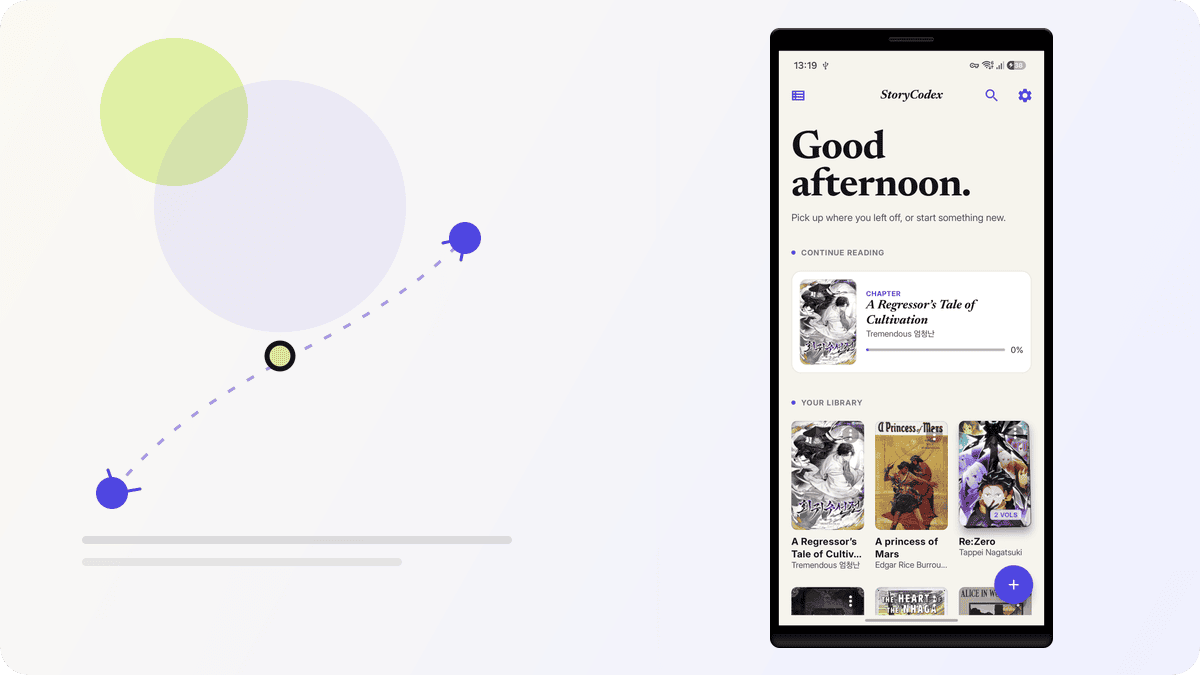
Modern fiction is longer than ever. A web novel can run for two thousand chapters, and a fantasy series can span fifteen books with a hundred viewpoint characters. Somewhere around chapter four hundred, a familiar feeling sets in: you remember the battle, but not who started it. You recognize a name, but not the relationship. A side character from chapter sixty walks back on stage in chapter nine hundred and the author clearly expects applause, while you are quietly wondering if this person is new. Most reading apps treat every book as a linear page turner: a library, a bookmark, maybe a dictionary. Nothing helps you carry the context that makes a long story worth reading.
StoryCodex is built around one idea: your reading app should remember the story the way you do, and no further. As you read, it quietly builds a private index of the things that matter, and it only ever knows what you already know. Think of it as a wiki for the book you are reading, but a wiki that grows exactly as far as your reading position and not one chapter beyond it. That last part is the whole trick. A fan wiki can tell you who the masked envoy really is because it was written by people who finished the series. The Codex cannot, because it has only ever analyzed the chapters you have finished.
A tour of the app, surface by surface
Read, listen, remember
Read with context
Tap any highlighted character name in the text and a compact lore lookup appears: key traits, recent developments, other connections, and a link to the full profile in the Story Codex.
Listen to anything
Three neural narration engines (Piper, Kokoro, and Supertonic) read your books aloud in 31 languages. Download a voice once and it works forever, offline; the neural voice guide compares all three.
Remember everything
The Story Codex tracks characters, places, factions, items, and timeline events per book, with Previously On recaps, summaries, and story insights on top.
Open a book's Codex and you get four tabs: Story, Characters, World, and Timeline. Story holds the running narrative state and chapter summaries. Characters holds a profile per person, including the aliases the text has used for them. World holds places, factions, and the concepts and mysteries the story keeps circling. Timeline is a milestone list of the events that actually moved the plot: arrivals, power-ups, character entries and exits, relationship changes, and reveals. Each tab is bounded to your position, so the Timeline shows the reveal only after the chapter that revealed it.
Two more surfaces sit on top of that. The Story Map turns the Codex into a visual graph: a relationship map of who is connected to whom, and a journey view that follows the story's geography in reading order. And when you come back after a week or a hiatus, the Previously On button in the reader rebuilds your context as a short recap, generated from your own position rather than someone else's summary of the ending.
The reading stats screen rounds it out: minutes and chapters per day, a streak, an optional weekly goal, and a daily reminder that stays quiet on days you have already read. Listening counts toward the same numbers as reading, because a commute chapter is still a chapter.
Underneath all of it sits the part that matters most to some readers: the whole thing is local first. The Codex is built by a model running on your phone, the voices synthesize on your phone, and there is no account to create. Optional cloud analysis exists for heavy chapters, as a labeled per-job choice, and the why local AI matters explainer maps exactly what leaves the device and when.
The demo library and the nine-stop tour
The fastest way to understand StoryCodex is to try the guided tour. On first launch, a bundled demo library arrives with the app, headlined by an EPUB of A Princess of Mars with its full Story Codex already built: characters, world entries, timeline, the works. A web novel item, a PDF, and a plain text document ride along so every import type is represented before you import anything of your own.
The tour itself is nine coach-marked stops over that demo book: the reader's narration button, the optional voice download, a Previously On recap, a tapped character name and its popup, the Codex tabs, and the Story Map. It takes about two minutes, and because the demo Codex is pre-built, nothing needs to download or analyze first. The demo book is also the one place free users get the complete relationship graph, so you can see the full map before deciding anything.
StoryCodex versus a typical reader app
| Feature | StoryCodex | Typical reader app |
|---|---|---|
| Story memory | Builds a spoiler-safe Codex per book | Only your bookmarks and progress |
| Offline narration | Neural voices, downloaded once | No TTS, or streaming-only voices |
| Catch up tools | Chapter summaries and previously on recaps | Manual back-reading |
| Character tracking | Profiles, aliases, relationships, timeline | Nothing built in |
| Privacy | Local first, no account required | Cloud-only AI by default |
Who is StoryCodex for?
StoryCodex is a good fit if you are
- A web novel reader who follows one or two thousand chapter series at a time
- An epic fantasy or sci-fi fan tracking dozens of characters and factions
- A commuter who wants to listen to books without a subscription
- Someone with a library of EPUBs, PDFs, and text files across devices
- A privacy conscious reader who wants AI features without uploading their books
It is just as fair to say where it fits. StoryCodex does not sell or provide books: it is a reader for fiction you already have or already read on the web, not a store. Kindle and Kindle Unlimited books stay out of reach, because DRM prevents any third-party app from reading those files. On-device analysis wants a reasonably capable phone, and on older hardware the optional cloud path picks up the slack. And if your reading life is a single short novel at a time, the reader and voices alone are worth the install; the Codex earns its keep once your stories start to sprawl.
First questions, answered
How much does it cost?
The reader, imports, and the core local features are free. Pro adds things like offline chapter saving, month and year stats ranges, and story insights. StoryCodex Cloud analysis is a separate pay-per-job credit system, not a subscription.
Which platforms does it run on?
Android and iOS. Everything above describes the same product on both.
Do I need an account?
No. Reading, importing, the Codex, and narration all work without one. An account only matters if you want optional services like cloud credits.
Where do the books come from?
From you. You import EPUBs and documents you own, or point the app at web novels you already read online. The app ships a small demo library for the tour, but it is not a content source.
Does it work offline?
Reading and listening do, once a voice is downloaded. Local Codex analysis also runs on-device. Fetching new web chapters obviously needs a connection.
Install the app, finish the nine stop tour over the demo book, and only then import your real library. The tour takes about two minutes and it teaches every feature this guide mentions.
StoryCodex is free to try on Google Play and the App Store. Import a serial, pick a neural voice, and your library works fully offline, no account required.
Keep the story clear
Try StoryCodex for free.
Read, listen, and remember any long story with a private, spoiler-safe story memory that lives on your device.

