 StoryCodex
Track Xianxia & LitRPG Characters and Ranks
Xianxia and LitRPG serials bury you in cultivation realms, sects, and aliases. Here is how to keep hundreds of characters and ranks organized.
 ForgeAppsUpdated September 19, 20269 min read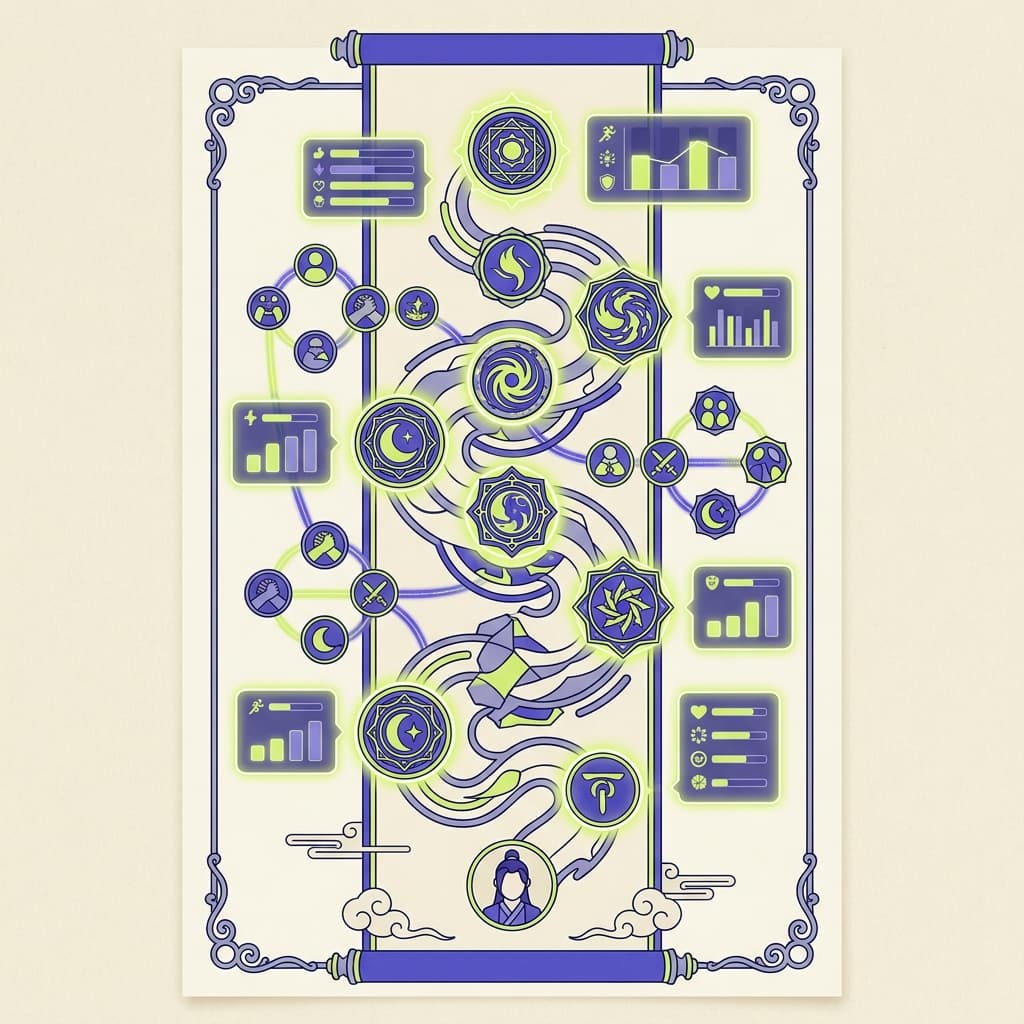
Progression Fantasy, Xianxia, Wuxia, and LitRPG web serials offer unmatched world-building and character growth. However, they present a unique challenge to readers: exponentially growing character lists, nested cultivation realms (Qi Condensation, Foundation Establishment, Golden Core, Nascent Soul), sect hierarchies, and stat screens. When an antagonist from 800 chapters ago re-emerges with a new realm title, remembering their past interactions becomes a daunting task.
The usual fixes all have the same flaw: fan wikis spoil the chapters you have not reached, and your own notes stop being maintained around book two. A spoiler-safe alternative is a reader that builds its own index as you go. StoryCodex keeps a per-book Codex of characters, factions, and terms that only ever reflects the chapters you have finished, which is exactly what a cultivation epic needs. What follows is how each piece of it maps to the genre's specific memory problems.
Why Progression Fantasy breaks human memory
The genre's five memory traps
Massive Cast Scaling
Protagonists travel across continents and planes, encountering new sects and factions in every major arc. By chapter 900 the cast list reads like a phone book.
Shifting Power Hierarchies
Characters who were terrifying bosses in arc 1 become minor background allies or mentors in arc 5, and their titles change as the ladder climbs.
Alias Proliferation
One cultivator accumulates a birth name, a courtesy name, a sect title, a masked identity, and an epithet the narration switches between without warning.
Translated Name Homophones
Translated web novels frequently feature similar-sounding pinyin names (Lin Fan, Li Fan, Liu Fan) that blur together within a single chapter, let alone across hundreds.
Buried Plot Threads
The mysterious medallion from chapter 40 and the sealed elder from chapter 200 both matter in chapter 700. Without an index, foreshadowing reads like filler.
Common Progression & Cultivation terms to track
- Cultivation Realm / Rank
- A character's power level tier. Profiles carry a power tier field, so a profile shows where someone sits on the ladder as of your chapter.
- Sect / Clan / Guild
- The factional alignment of a character, including elders, disciples, rivals, and allied houses. Tracked as faction entities with leaders and headquarters.
- Dao / Martial Intent
- Specialized concepts, attributes, or elemental affinities associated with key fighters. Tracked as named concepts inside the power system.
- Character Aliases
- Multiple names used for the same person: real name, courtesy name, title, rank honorific, or masked identity. All merge onto one profile.
- Inner / Outer Disciple
- A character's standing inside a sect. Roles like 'protagonist', 'antagonist', and 'supporting' are tracked on the profile alongside faction membership.
- Named Artifact / Pill / Manual
- Items with owners and tiers: weapons, artifacts, pills, scrolls, armor. The Codex tracks who holds each one and where it came from.
- Breakthrough
- A realm advancement, logged on the timeline as a milestone the moment it happens, so you can see exactly when someone leveled.
- Open Thread
- An unresolved mystery the Codex keeps filed as open or foreshadowed until the chapter that resolves it.
One character, five names
Here is the scenario every xianxia reader knows. Chapter 60 introduces 'Senior Brother Meng' of the Azure Mystic Sect. He vanishes for two hundred chapters. Chapter 265 brings a masked adviser called the 'Grey Envoy'. Chapter 300 promotes someone to 'Elder Meng of the Outer Council'. Chapter 412 finally names him 'Meng Zhou'. Four surfaces, one person, and the only reason you can follow it is that every name lands on the same profile.
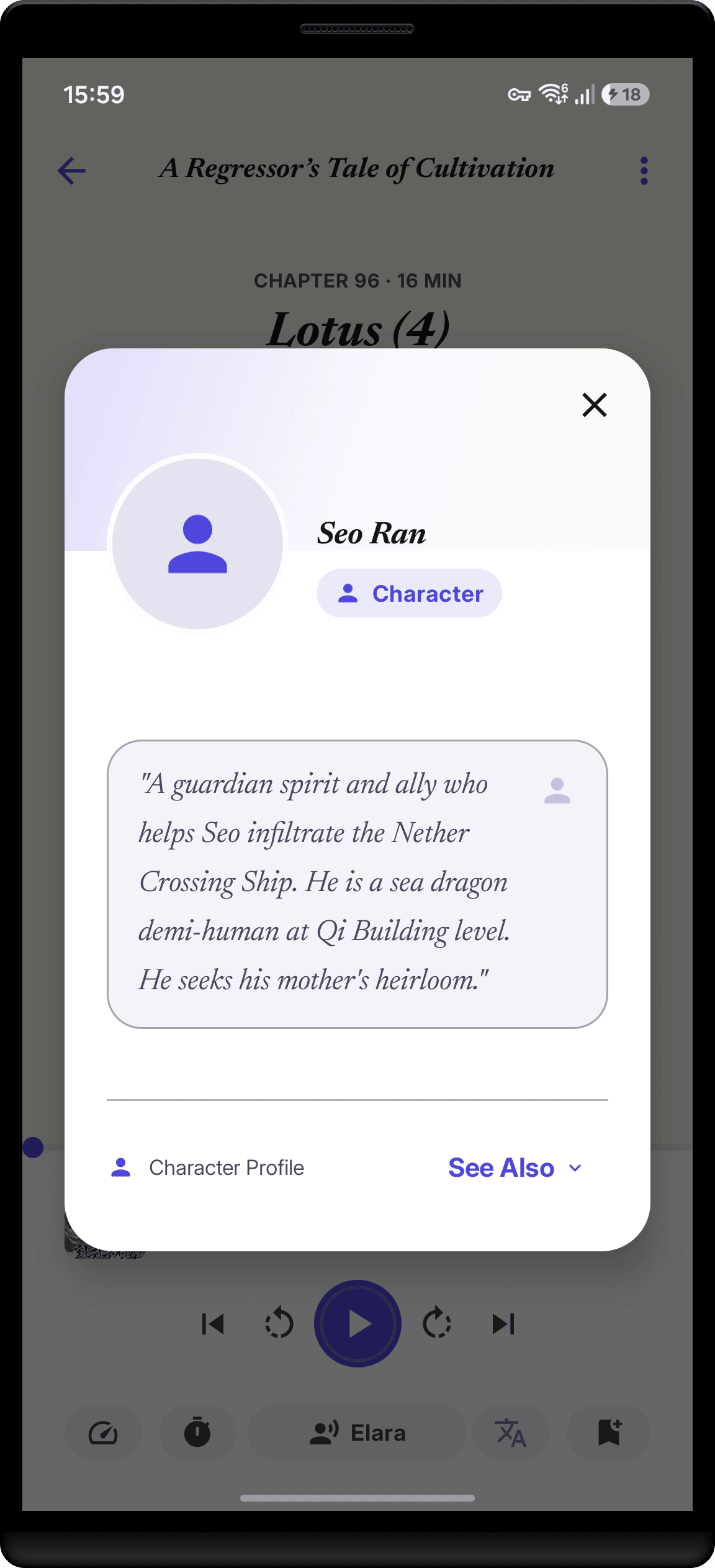
StoryCodex merges them in layers: exact matches against canonical names and stored aliases first, then title-stripped stems ('Elder Meng' and 'Senior Brother Meng' share a stem), then epithet containment, so 'Sea Dragon King Seo Hweol' resolves to 'Seo Hweol' on first use. Each accepted alias becomes a chip on the profile, so opening Meng Zhou shows every face he has worn. Just as important are the refusals: a shared surname does not merge people, so 'Seo Hweol' and 'Seo Eun-Hyun' stay separate, and a name that belongs to both a place and a person is matched only within its own type.
Realm ladders are a tree, not a list
Cultivation systems are not flat vocabularies. 'Qi Condensation' has stages, 'Foundation Establishment' sits above it, and a sword art like 'Severing Mountain' owns named moves beneath it. The Codex models that directly: concepts are tagged by system (cultivation, magic, LitRPG, qi) and linked by hierarchy edges, so 'early Foundation Establishment' files itself as a substage of 'Foundation Establishment', and a named technique files under its parent art. When a story accumulates enough concepts, the World tab groups them into the ladder shape instead of an alphabetical pile.
People connect to the ladder too. A character profile carries a power tier with an ordinal rank, so 'Elder Meng' does not just say 'strong', it places him on the same ordered scale the story uses. When the protagonist finally breaks through, the event lands on the timeline as a milestone, and the profile catches up at that chapter rather than retroactively. That last part matters: your chapter-300 view of a rival still shows the realm you knew about at chapter 300.
Sects are factions, and factions have memories
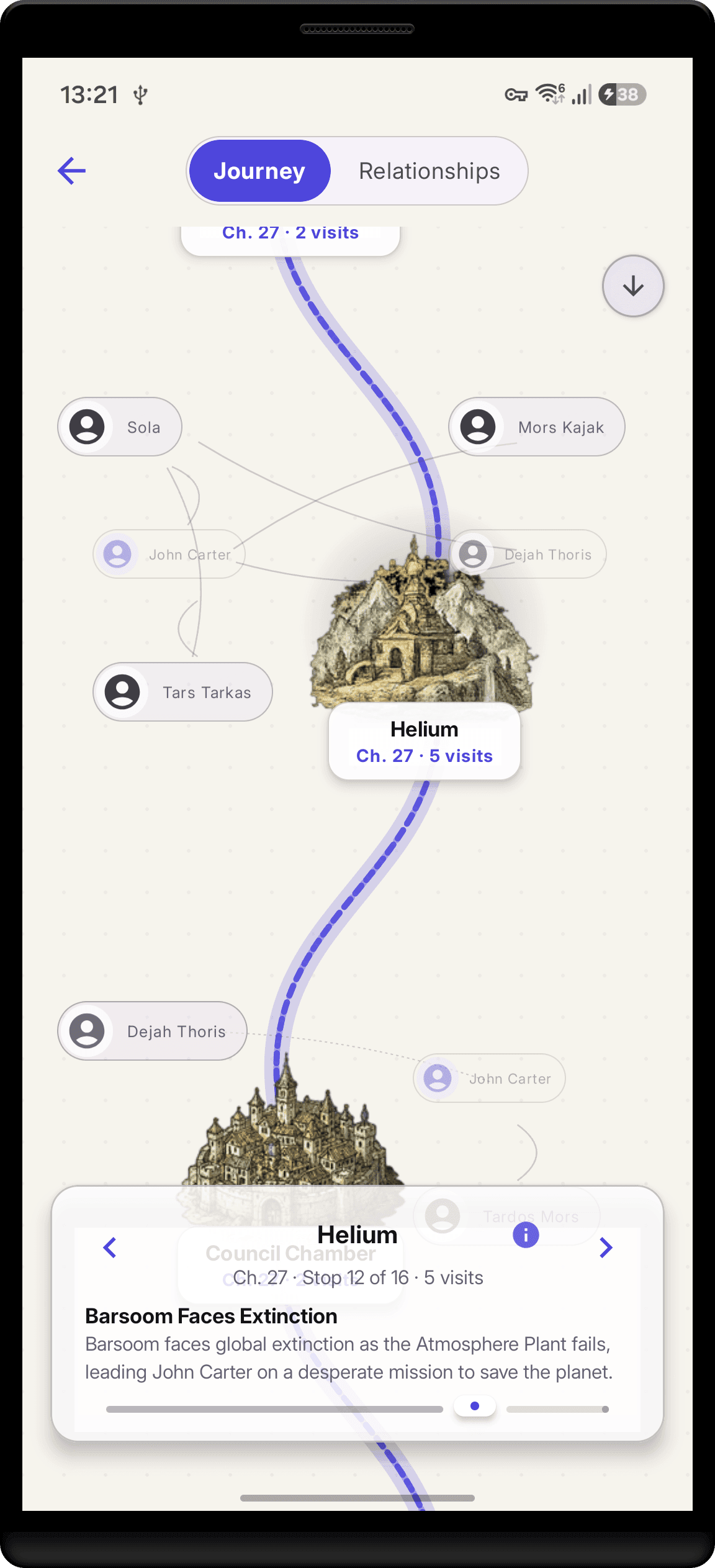
A sect in the Codex is a full faction profile: kind (sect, clan, kingdom, guild, cult, or corporation), its leader, its parent faction, its headquarters, and its alignment toward the protagonist as ally, neutral, enemy, or unknown. That alignment field earns its keep in long serials. When the Iron Banner Clan reappears after four hundred chapters, its profile tells you whether they were the allies who sheltered the protagonist or the rivals who hunted him, and the relationship graph shows the individuals who tie the factions together: who is a member of, leader of, or disciple of whom.
LitRPG: tracking the numbers
LitRPG serials swap sects for guilds and realms for levels, but the bookkeeping is the same shape. Named items are tracked with an owner, an item kind (weapon, artifact, pill, scroll, armor), and a tier with an ordinal, so 'Dragonbone Blade, tier 4' stays attached to whoever holds it now rather than whoever held it first. Stat-heavy systems file their named mechanics as LitRPG-tagged concepts, and level-ups and new skills surface as timeline milestones instead of disappearing into another blue status box you will never scroll back to.
The homophone problem, solved by refusing to merge
Translation romanization produces casts where 'Lin Fan', 'Li Fan', and 'Liu Feng' can coexist in one scene. A tracker that merges aggressively is worse than none, because one bad merge poisons every later chapter. The Codex matcher treats surname-only similarity as a red flag, not a match: two people whose given names differ never fold together, and any incoming full name that conflicts with a different full name on file forces a new profile. You keep three clean entries instead of one corrupted one.
The threads you are still waiting on
Xianxia authors plant mysteries hundreds of chapters early: the sealed coffin, the unnamed benefactor, the medallion's other half. The Codex files these as mystery entries with a status of open, foreshadowed, partially revealed, or resolved, so the World tab doubles as a list of debts the story still owes you. When the coffin finally opens, the entry resolves at that chapter, which also means it cannot leak the answer early: at your reading position it still reads 'open'.
How StoryCodex keeps Xianxia & LitRPG readers on track
- 1
1. Automatic alias resolution
The matching engine links titles like 'Senior Brother Meng' and 'Elder Meng' to the exact same dossier, while refusing to merge people who merely share a surname.
- 2
2. Inline term lookups
Names, sects, and realms appear underlined in the chapter text. Tapping one opens a card with recent changes and who shares the scene, all lensed to the chapter you are on.
- 3
3. Timeline progression
The Timeline tab logs breakthroughs, arrivals, first appearances, deaths, betrayals, and reveals as milestones tied to their chapter, so an arc's shape is one scroll away.
- 4
4. Recaps on demand
The 'Previously on…' sheet rebuilds the current arc and the latest milestones in seconds, and can read itself aloud before the chapter narration resumes.
Tracking the system, not just the cast
Cultivation stories also bury progress in the world itself: realm ladders, dao concepts, sect techniques, and named artifacts all carry meaning that accumulates over hundreds of chapters. The World tab of the Codex indexes factions, places, items, and concepts the same way it indexes people, so 'Azure Mystic Sect' and 'Foundation Establishment' get profiles too. If you prefer listening over reading, multilingual neural TTS handles romanized names and honorifics without mangling every 'Xiao' and 'Zhang'.
Returning to a serial after weeks away is where this pays off hardest: a spoiler-gated 'Previously On' recap plus the Timeline tab rebuilds arc context in minutes, and our guide on tracking 1,000+ chapter novels without spoilers covers the full system end to end.
Xianxia and LitRPG tracking questions
Does it understand cultivation realms specifically?
Yes. Concepts carry a system tag (cultivation, magic, LitRPG, qi) and hierarchy edges like 'stage of' and 'substage of', so realm ladders and technique trees file themselves in order rather than as loose terms.
What about named spirit beasts and mounts?
A named creature with ongoing story weight is tracked like any other character, with a kind field marking it as a beast, pet, spirit, or construct. Generic interchangeable monsters are deliberately left out.
Will the Codex spoil a character's secret identity?
No. Profiles only know what your finished chapters revealed. If 'Grey Envoy' is unmasked in chapter 900, tapping the name at chapter 400 shows the masked adviser the story has shown you, not the man underneath.
What if two different characters really do share a name?
They get separate profiles. Conflicting full names and differing given names both force a split, so a junior disciple named after his ancestor does not inherit the ancestor's history.
Bingeing a multi-volume Xianxia series? Make sure to place all imported volumes inside one 'Series' container in StoryCodex so cultivation realm definitions and character dossiers span the entire epic.
StoryCodex is free to try on Google Play and the App Store. Import a serial, pick a neural voice, and your library works fully offline, no account required.
Keep the story clear
Try StoryCodex for free.
Read, listen, and remember any long story with a private, spoiler-safe story memory that lives on your device.

