 StoryCodex
Story Map: Journey & Relationships
Two visual ways to understand your story: the Journey route through its stops and the Relationships network behind the plot. A feature tour with examples.
 ForgeAppsUpdated September 29, 20267 min read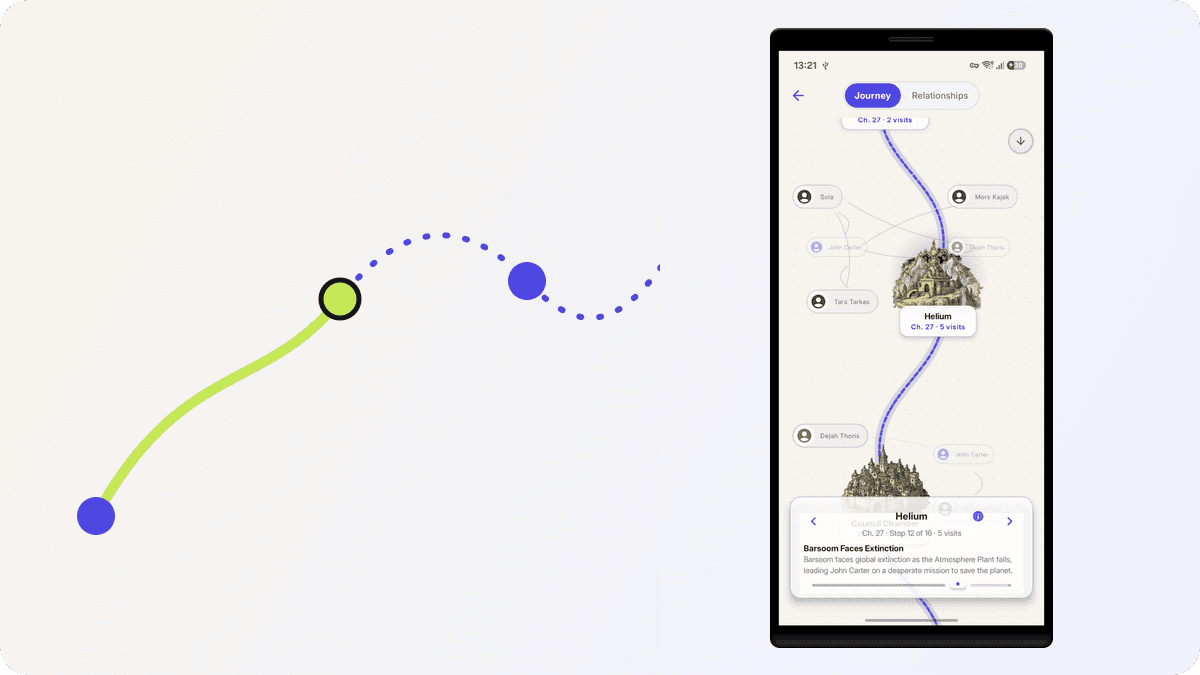
Long stories are geography: who moved where, who met whom, which faction holds which city. Story Map turns that geography visual with two linked views, switched by the chips at the top of the screen: Journey and Relationships. Both render the same Story Codex data, just projected differently, and both are bounded by your reading position.
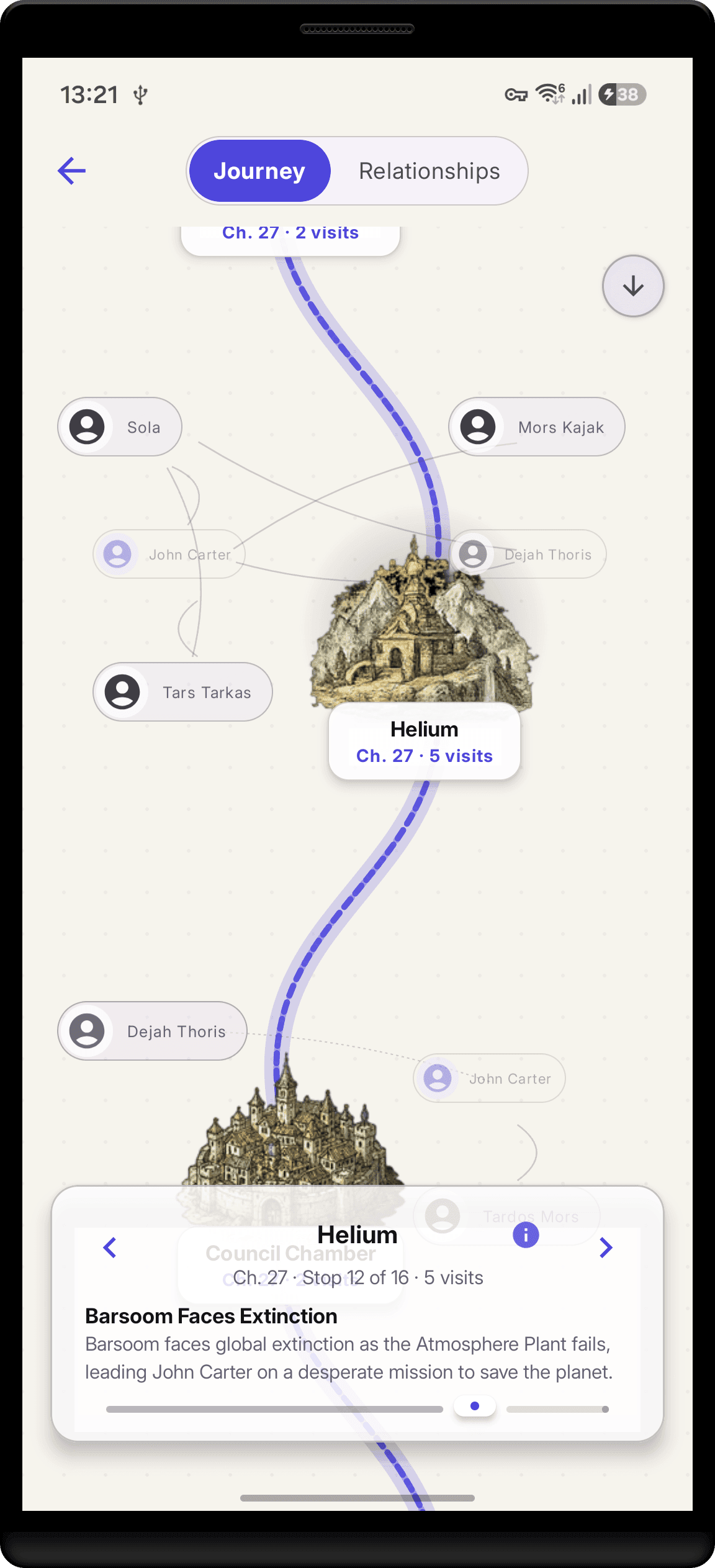
Journey: the route through your story
Journey lays out the story's key stops in reading order, connected like a route. Each stop is a place or faction that characters actually visited on the page, ordered by first visit and labeled with the chapter span it covers, like 3-10. Open a stop and you see who was there: every visitor carries a return count, the purpose recorded for their first visit when extraction captured one, and a marker for whether the stop is still their latest known location. Stops also show the relationships that existed between the people sharing them, and a lighter outer ring of context entities, characters and factions tied to someone present even when they never set foot there themselves, so a node can read enemy of the marsh clans without inventing a visit.
Two pieces of tidying keep long novels readable. A stop that names an adjacent stop as its parent location rolls up into it as a sub-place, so the palace inside the capital becomes one stop labeled with both. And once a journey grows long, runs of minor stops, single one-chapter stays that were never revisited and hold no faction ties, fold into a via waypoint that keeps them stored but off the main route. The first and last stops never fold: where the story began and where it currently is are always visible. A timeline scrubber underneath steps only through chapters that actually moved the journey, and a stop navigator jumps the route without dragging.
A third view is in development
A spatial view called Atlas is being built but is not in the app yet. The idea: organize the world by place rather than time, with places nested inside each other using the containment links extraction records, and observed travel between places drawn as directional flows. The groundwork is already running: chapter analysis has been recording the spatial data underneath, so when the view ships it will have real material to draw instead of starting empty.
Relationships: the network behind the plot
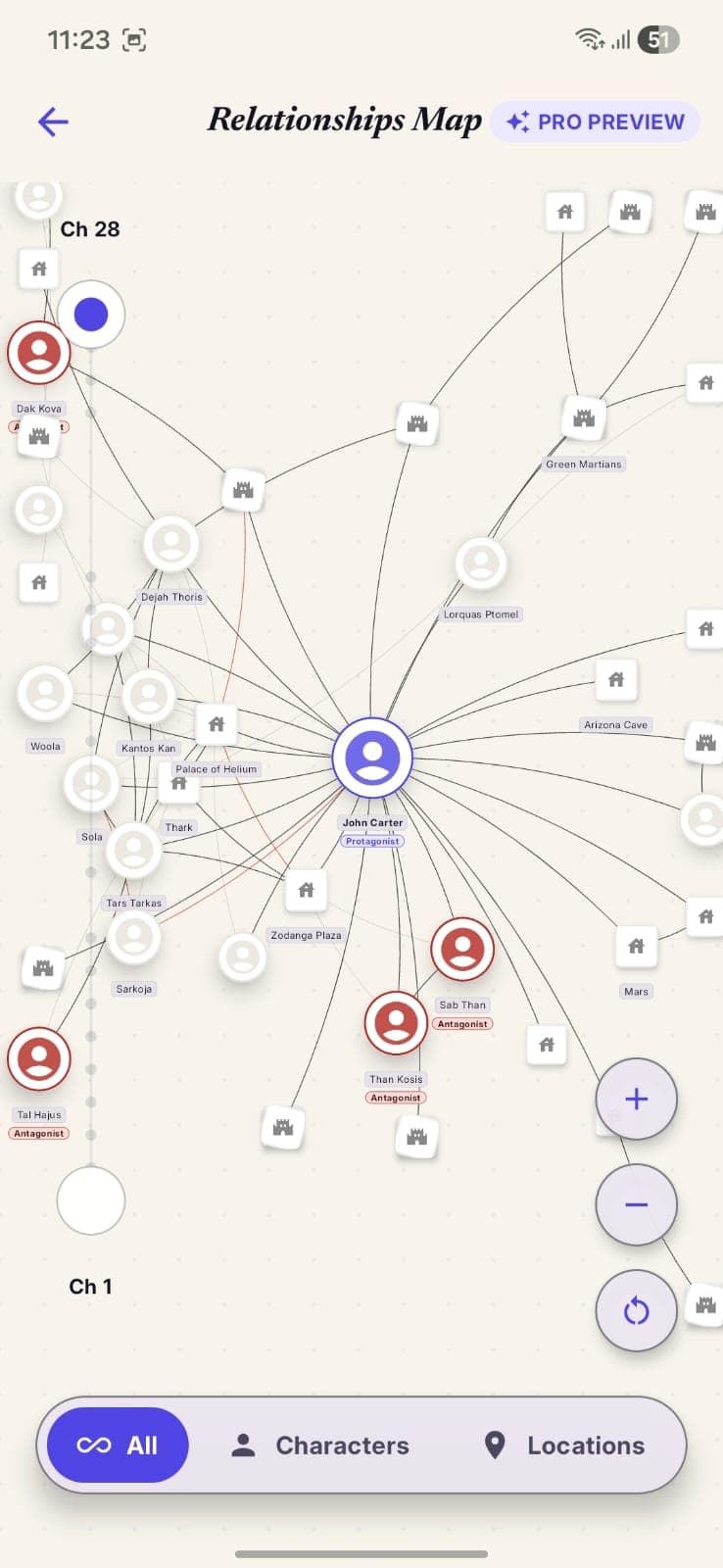
Relationships renders the cast as a network graph. Node size encodes who matters: the protagonist is largest, then the antagonist, then characters scale with importance score and appearance count, so the people the story keeps returning to are literally the biggest dots. Edges come in two kinds. Explicit ones carry the relationship label extraction recorded, ally, rival, student of, direct superior, and structural ones fall out of the profiles themselves: member of a faction, located at a place, ruled by, led by, headquartered at, branch of. Antagonistic edges, anything like enemy, rival, hostile, betray, at war, render distinctly so conflict reads at a glance.
The scrubber is where the graph earns its name. Drag it backward and the view resolves every pair's latest relationship as of that chapter, so you can watch the exact point where ally became enemy and tap the edge to see how and when the link formed. With hundreds of chapters the scrubber does not tick every one; it marks a bounded set of milestones, arc boundaries, chapters where major relationship shifts landed, and fills the rest evenly. For genres where the relationship web is the plot, this view alone earns its keep; our spoiler-safe romantasy reading guide goes deeper on that case.
Where the map gets its data
Every node and edge comes from the same extraction pass that fills your Codex, not a separate database. The visit records behind Journey stops are written during the appearances phase of chapter analysis, relationships come from the dynamics pass, and place and faction profiles supply the containment, ruling, and headquarters links that will feed Atlas when it ships. Because every row is stamped with the chapter it came from, scrubbing the timeline is the spoiler gate rendered as a slider: the furthest position is always your own reading position, and nothing ahead of you exists to reveal.
Story Map questions, answered
Can scrubbing the timeline spoil later chapters?
No. The map only knows about chapters you have finished, so the furthest point on the timeline is your own reading position. There is nothing ahead of you to scrub into.
A character appears twice under two names. Now what?
Give the Codex a few more chapters. Alias resolution runs in the background during extraction, nominating similar pairs and adjudicating a handful per chapter, and the map follows the merged profile once they confirm.
Why is a city missing from the Journey?
Journey stops are built from recorded visits, so a place that is only talked about and never visited stays off the route. It can still appear as outer-ring context on a related stop, and its Codex profile still exists in the World tab.
Where is the Atlas view?
Atlas is in development and not in the app yet. The extraction pipeline already records the spatial data it needs, so it will launch with real material rather than an empty map.
Is the Story Map free?
It ships with StoryCodex Pro, and any book where you have spent StoryCodex Cloud credits unlocks it too. The bundled demo book previews the map for everyone, so you can try it before your own library is big enough to map.
Which view answers which question
| View | Use it when you ask |
|---|---|
| Journey | What is the sequence of where the story has been, and who was at each stop? |
| Atlas (in development) | Where is everything, who holds it, and how do characters move between places? |
| Relationships | How did these characters become connected, and when did it change? |
Reading scenarios where the map earns its keep
Mystery re-reads
A name drops in chapter 600 that you last saw in chapter 200. Scrub Relationships back to find the chapter the edge formed, then jump to the scene.
Travel arcs
Journey-heavy stories blur together. The route view preserves the order of stops and who was aboard at each leg, so the waypoints stay separable.
Faction wars
In political arcs, the Relationships graph keeps the conflict legible: hostile edges render distinctly, and each faction node ties back to its members and headquarters in the Codex.
Coming back from hiatus
Open Journey to see where the story has traveled, then Relationships to see who still matters. Between the two and a recap, most lost context returns in minutes; the hiatus guide has the full workflow.
Practical uses
- Before a new volume: check Journey to recall the arc you are continuing.
- While reading political fantasy: check the Relationships graph to remember which house is at war with which.
- After a plot twist: visit the Relationships graph and trace the edge back to its chapter of origin.
- When a name sounds familiar: open its node and read the edges instead of rereading.
- Onboarding: the bundled demo book arrives with a fully built Story Map, so try both views before your own library is big enough to map.
The map also doubles as a re-entry point. If you are coming back to a novel after a long hiatus, open Journey first to see where the story has traveled, then skim the Relationships graph to see who still matters. Between the two views and a recap, most of the lost context comes back in a few minutes.
StoryCodex is free to try on Google Play and the App Store. Import a serial, pick a neural voice, and your library works fully offline, no account required.
Keep the story clear
Try StoryCodex for free.
Read, listen, and remember any long story with a private, spoiler-safe story memory that lives on your device.

