 StoryCodex
Spoiler-Safe Romantasy: Track Every Character
Romantasy mega-series hide secret identities and bond reveals behind huge casts. Here is how to track plots and discuss them without spoilers.
 ForgeAppsUpdated September 29, 20267 min read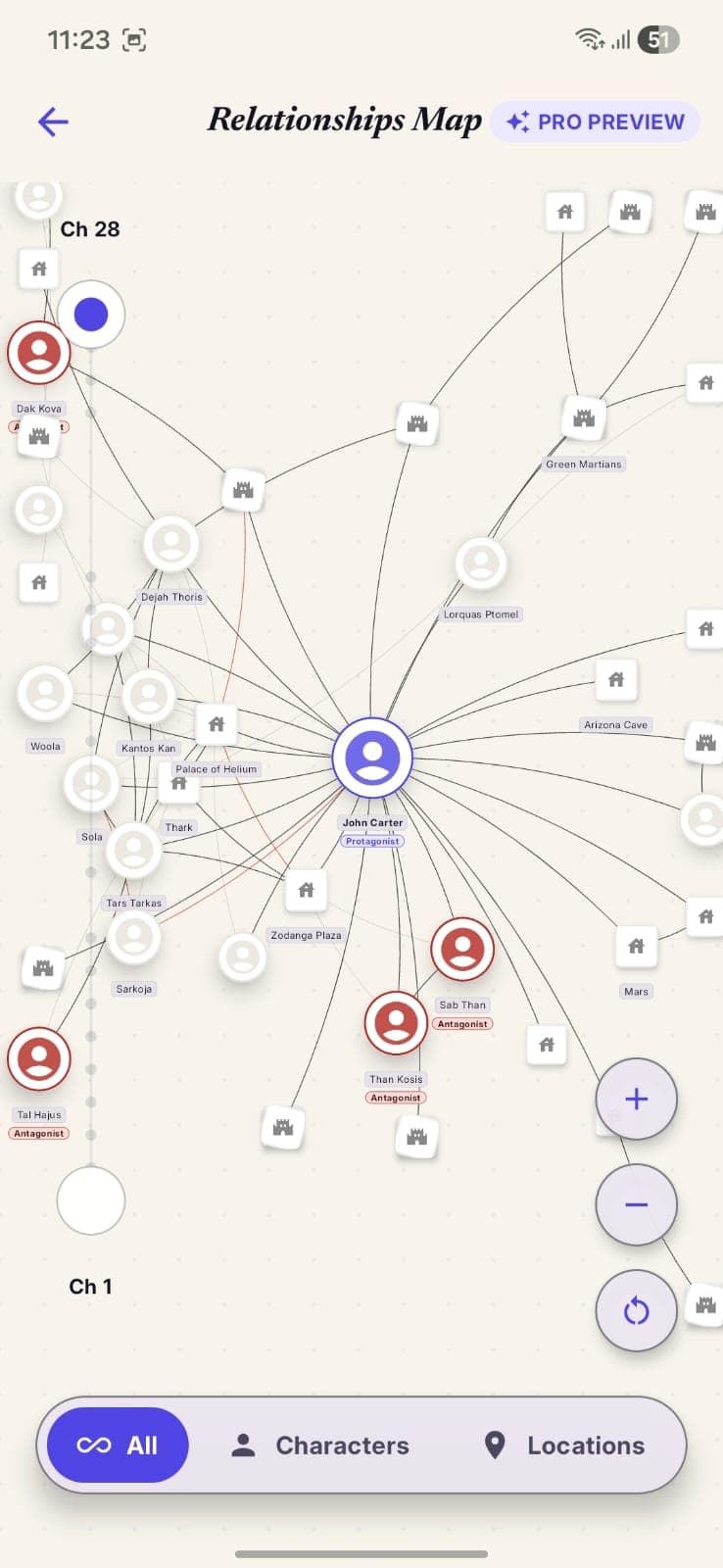
Romantasy runs on secrets. The genre's biggest series, A Court of Thorns and Roses, Fourth Wing and The Empyrean, Throne of Glass, From Blood and Ash, all share the same architecture: a cast of dozens spread across courts, war colleges, and rival kingdoms, where a character's true identity or mating bond can be the payoff of an entire book. Keeping track of who is who is hard enough. Keeping track of who is who without learning who they secretly turn out to be is the real problem.
The genre adds its own tracking problems on top. Romantasy characters collect names the way fantasy characters collect scars: a birth name, a court title, a nickname, a masked persona, sometimes a true name that is itself a plot point. Fae courts rotate allies and enemies between chapters. A villain in one book is a love interest two books later, and a throwaway side character in the opening act returns as the person holding the third-act reveal. Add the genre's habit of time skips between volumes, where book three opens years after book two with the cast reshuffled, and ordinary notes and bookmarks were simply not built for this.
Why the internet is a minefield for romantasy readers
Every place readers go for help is optimized for people who have already finished. Fan wikis document a character's endgame state on the first line of their page, so looking up a minor fae lord in book one can reveal the book three betrayal. BookTok thumbnails and titles announce mating-bond reveals outright, and the algorithm does not care where you are in the series. Reddit threads marked for a single book still leak, because commenters forget which reveal happened in which volume. Even a search engine autocomplete can finish a name you were not supposed to know yet. The information you want exists everywhere; what does not exist is a version of it bounded to your chapter.
What spoiler-safe discussion actually requires
So what apps allow for spoiler-safe discussions of romantasy plots? The honest answer is that a discussion is only safe if everything in it is bounded to a specific chapter. A spoiler-safe tool has to know exactly what you have read, refuse to look ahead, and treat a character's secret identity as unknown until the text reveals it. That is the design behind the Story Codex: a private, on-device memory that only analyzes chapters up to your current position, so its answers can never reach past your bookmark. When a human community is involved, the same discipline has to be social, which is why the norm that works is chapter-tagged discussion: threads labeled with the furthest chapter covered, where everything said is fair game up to that line and nothing beyond it.
Romantasy's tracking problems, mapped to Codex features
Sprawling casts: bounded character profiles
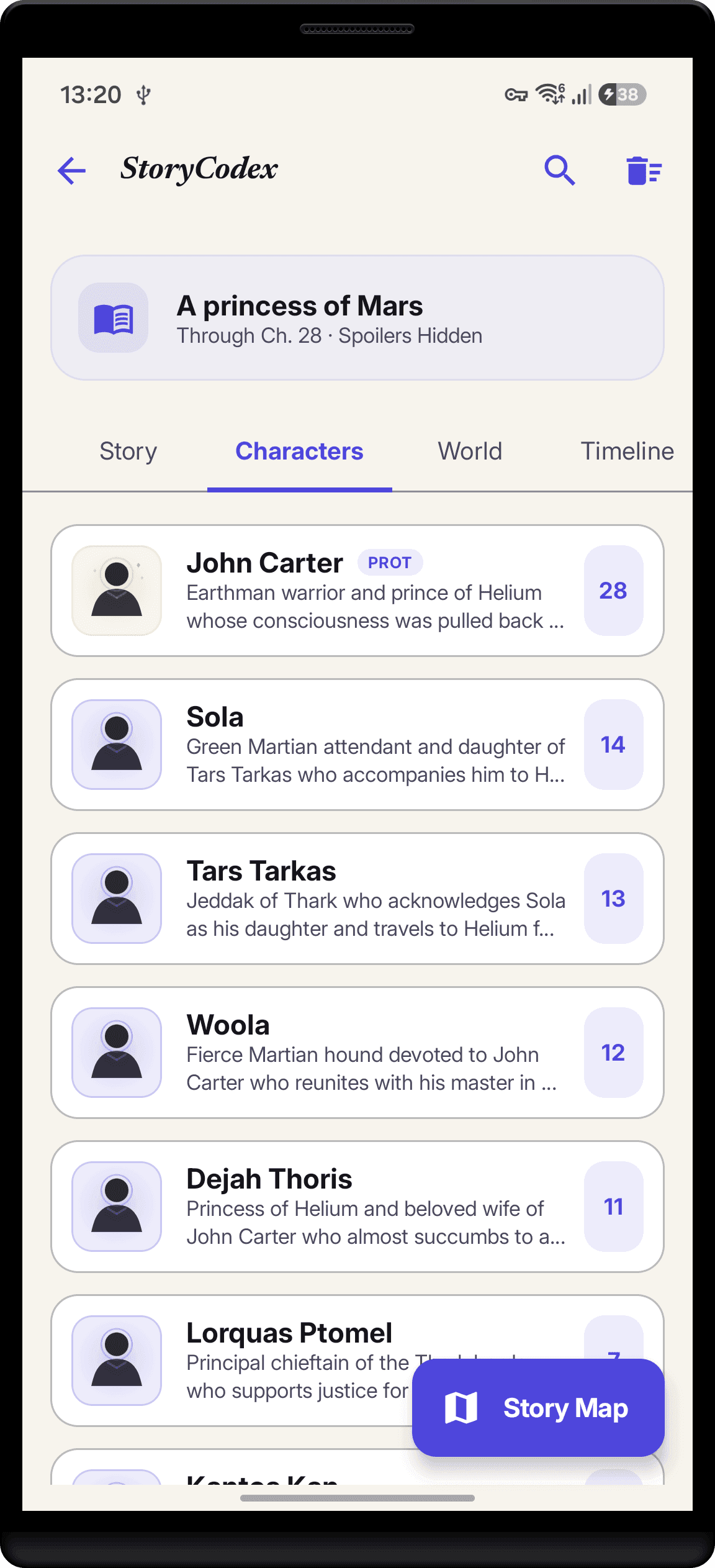
Every profile in the Characters tab reflects only the chapters you have finished. Ask about a character mid-book-two and you get who they are as of your chapter: their traits, their recent developments, their known connections. Not who the fandom knows them to be.
Secret identities: aliases that stay sealed
When the text refers to a masked stranger, a disguised envoy, or an unnamed narrator, the Codex tracks them under that alias. When the story itself reveals the identity, the profiles merge and the history combines. Before the reveal, the alias stands alone and gives nothing away.
Fae courts and shifting alliances: the World tab
Courts, kingdoms, war colleges, and rival houses live as world entries with their own profiles, so a court's politics stay legible across five books. When an ally becomes an enemy, the entry reflects it from the chapter where it happened, not before.
Bonds and betrayals: the relationship graph
Romantasy relationships are structural: sworn oaths, rival houses, bonds that form on the page. The relationship graph in the Story Map lays out who is connected to whom as of your reading position, so a mating bond appears in the graph when the story forms it, not when the fandom ships it.
Reveals and time skips: the Timeline
The Timeline tab keeps a milestone list of the events that moved the plot, typed by kind: character entries and exits, relationship changes, reveals, and world-scale events. After a multi-book time skip, it is the fastest way to see what the story itself has already told you.
Coming back cold: Previously On
Returning after months away, or picking up the latest release in a long saga? The Previously On recap rebuilds your context from your own reading history, bounded to your position, instead of a wiki summary written from the end.
Discussion norms that keep threads safe
How chapter-bounded discussion works in practice
- 1
Tag the thread to a chapter
The thread title carries the furthest point covered, like book 2 through chapter 34. Everyone in it has read at least that far, and nothing past it is allowed. That one rule replaces every spoiler-tag guess.
- 2
Check the Codex before you ask
Half of all spoiler accidents start as an innocent question: wait, who is he again? Look it up in the bounded Codex first. If the answer is not in your chapters yet, the question itself was a spoiler.
- 3
Recap instead of re-reading
When a friend is behind, generate their Previously On at their position rather than summarizing from your memory of the ending. Your memory knows who the envoy is; their recap does not.
- 4
Move up in steps
When everyone finishes the next chunk, retag the thread. Discussion communities that advance in chapter steps stay safe indefinitely, because nobody ever has to guess what the group has read.
Getting your romantasy library into StoryCodex
If you own EPUB copies of your romantasy books, import them directly into your library and the Codex builds alongside your reading. Web serial romantasy imports by URL from supported sources, the same flow described in how to import any web novel. One boundary worth knowing: books locked inside Kindle or Kindle Unlimited DRM cannot be imported, because the DRM prevents any third-party app from reading the file. EPUB files you own, from Kobo, direct author sales, or other DRM-free stores, work cleanly.
For readers juggling a whole saga, StoryCodex groups multi-volume series together, so the character memory you built in book one carries into book four. That matters in romantasy, where a side character introduced early can return three books later as a love interest or a villain, and where a between-volume time skip means the cast you left is not quite the cast you rejoin.
Spoiler-safe romantasy, answered
Can I discuss a book without risking later-book spoilers?
Inside StoryCodex, yes. Every answer comes from the bounded Codex, which only knows chapters up to your reading position. For human discussions, chapter-tagged threads are the norm that works, but only a tool that literally cannot read ahead is fully safe.
What happens to a character profile after a big identity reveal?
The alias and the true identity merge into a single profile once the reveal appears in a chapter you have read, preserving the full history of what each identity did.
I am returning after a long hiatus. Do I have to re-read?
No. Open the book, use the Previously On recap, and skim the Timeline for the big beats. The hiatus catch-up guide walks the full routine.
Does this work for rereads?
Yes. On a reread, your Codex from the first pass already knows the series, and recaps let you jump back into any arc without rebuilding context from scratch.
Does the Codex send my books or reading progress anywhere?
No. Extraction and summarization run on device, and your library stays local. Nobody sees which chapter you are on, including us.
Before starting a new romantasy release, open the relationship graph filtered to the main couple and their court. Thirty seconds there usually recovers more context than an hour of spoiler-dodging wiki browsing.
StoryCodex is free to try on Google Play and the App Store. Import a serial, pick a neural voice, and your library works fully offline, no account required.
Keep the story clear
Try StoryCodex for free.
Read, listen, and remember any long story with a private, spoiler-safe story memory that lives on your device.

