 StoryCodex
Why Audiobooks Need Character Trackers
Audio-first reading has a memory problem: there is no page to scan back. Spoiler-safe character dossiers fix the 'who is speaking?' problem.
 ForgeAppsUpdated September 19, 20266 min read
Audiobook listening is convenient, but it places heavy demands on auditory memory. On a printed page your eyes can flick back two paragraphs to check a speaker's name; an audio stream offers no such anchor. When an epic fantasy introduces forty side characters in a single banquet scene, or a narrator says 'the swordsman from the northern provinces' instead of a name you half-remember, even attentive listeners lose track. The 'who is speaking?' problem is the single biggest reason people abandon audio for long, cast-heavy fiction.
Why audio makes names harder than text
Reading gives you three memory hooks that listening strips away. First, the visual shape of a name on the page; seeing 'Wei Chang' spelled out is itself a memory cue that hearing the syllables never provides. Second, spatial recall: readers remember roughly where on a page or how far into a chapter a detail appeared, which makes flipping back feel effortless. Third, control of pace: text lets you slow down on a dense introduction paragraph, while audio marches on at a fixed rate. Web novels amplify all of this because they are serialized over years, spread across hundreds of chapters, and fond of titles, ranks, and epithets. The same person appears as 'Wei Chang', 'Lord Wei', 'the Northern General', and 'father' within a few chapters, and audio gives you no spelling to search for, so a name heard once at hour three means nothing at hour nine.
Why the usual fixes fail
Audiobook listening myths vs. reality
Audiobook listeners don't care about character details
Listeners care deeply, but standard audio players ship with no visual tools or character reference sheets at all.
You can pause and check a fan wiki when a name slips
Wiki pages are written to the end of the story. Looking up a side character mid-book routinely spoils betrayals and deaths chapters ahead.
Syncing text and audio requires buying the book twice
StoryCodex pairs synchronized text with on-device neural narration in one app, so the page itself becomes your reference.
A worked example: you are three hundred chapters into a cultivation epic, listening on the drive home, when the narration mentions 'the Northern General's second oath'. You know the title rings a bell but cannot place the man. In a paper book you would flip back; in a plain audio app you would shrug and hope it does not matter. In StoryCodex, that name in the text is tappable, and it resolves to a card built only from chapters you have already covered: his aliases, the chapter he first appeared, when he was last active, and who he is connected to. Ten seconds, no spoilers, back to the road. This is exactly where a spoiler-safe story memory earns its keep.
The solution: synchronized visual lore cards
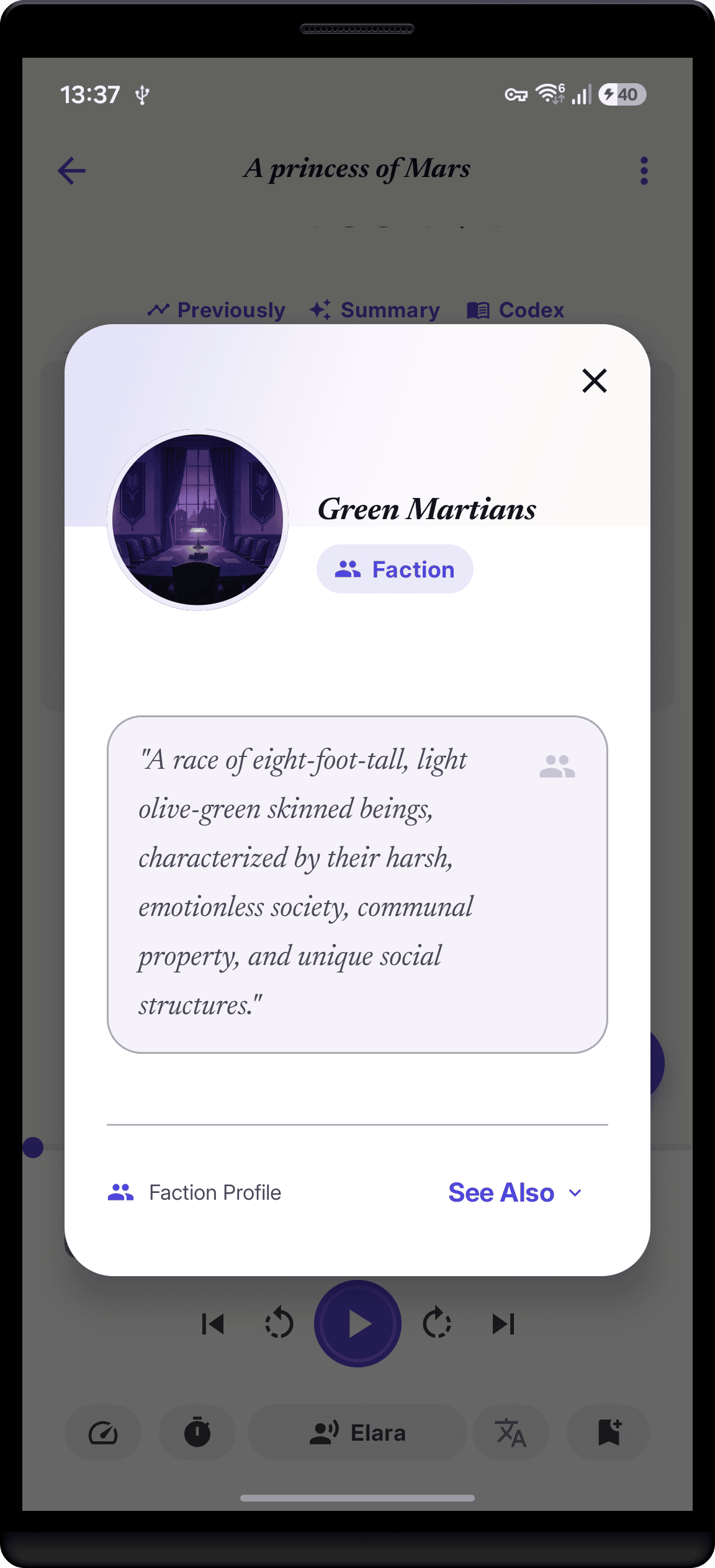
StoryCodex bridges text and audio by running real-time sentence highlighting alongside on-demand character lookups. If a name is voiced and you do not recall the role, tap the name on screen to see a compact dossier: aliases, the chapter it first appeared, when it was last active, and who it is connected to, all capped at your current chapter so nothing ahead is revealed. Alias merging means 'Lord Wei' and 'Wei Chang' resolve to the same profile instead of two confusing half-records, which matters far more in audio than in print, because epithets arrive as sound with no spelling to match.
The Codex screen organizes the same memory for bigger lookups: a Story tab for arc progress, a Characters tab listing everyone the story has introduced so far, a World tab for factions and locations, a Timeline tab for event order, and a relationship graph for tracing who owes what to whom. Before a battle arc where twelve sects collide, two minutes in the Characters tab and the graph replaces an hour of confused rewinding.
This matters most in genres built on sprawling hierarchies. Xianxia and LitRPG serials stack cultivation ranks, sect titles, and evolving class names on every character, which is why the guide on tracking xianxia and LitRPG characters pairs so well with audio listening: the Codex remembers the rank ladder so your ears do not have to.
The honest scope: the Codex lives on the read side
Worth saying plainly: a lore card needs a glance at the screen. It is not a voice you can quiz while your hands are on a barbell. The workflow that actually works is a read-listen handoff. Before a session, especially after a gap, skim or narrate the 'Previously on…' recap from the reader; when it finishes, StoryCodex can roll straight into the chapter audio. During listening, treat lookups like checking a map: a red light, a rest between sets, the walk between subway cars. And when a name slips mid-sentence, the one-sentence skip on the lock screen replays the line, so the glance and the rewind take seconds together. The recap exists precisely because audio listeners lose context faster than page readers: there is no marginalia in an audio stream, and weeks between sessions erase more than they do for eyes.
Audiobook listening shouldn't mean guessing who is speaking. Combining neural voice narration with a spoiler-safe story memory turns complex fantasy audiobooks into a seamless experience.
Common questions
Does the character tracker work while fully hands-free?
The lore lookup needs a glance at the screen, so treat it like checking a map: tap during a red light or a rest between sets, not mid-squat. For stretches where you cannot look at all, read the Codex Characters tab or play the narrated 'Previously on…' recap before the session instead.
Will the dossier spoil future chapters?
No. Codex profiles are built only from chapters you have already read or heard, so a card reflects what the story has revealed up to your current position. 'First seen' and 'Last active' stay inside that boundary too.
Can the recap itself be read aloud?
Yes. The 'Previously on…' recap in the reader can be narrated with the same neural voice, and with the keep-reading option it hands straight into the chapter when it finishes, so the whole warm-up stays hands-free.
What if I only listen and never look at the text?
That works, but the tracker helps most when you pair the two. Even a five-second glance at a tapped name replaces minutes of rewinding and guessing.
How to avoid losing track during audiobooks
- Glance at inline character popups when new names are voiced.
- Review the Codex Characters tab before starting major battle arcs.
- Use the relationship graph to trace house allegiances in political fantasy.
- Check the Timeline tab if you suspect you missed a time skip.
- Play the narrated Previously On recap after any long gap.
- Replay a missed line with the one-sentence Skip back button instead of scrubbing audio.
StoryCodex is free to try on Google Play and the App Store. Import a serial, pick a neural voice, and your library works fully offline, no account required.
Keep the story clear
Try StoryCodex for free.
Read, listen, and remember any long story with a private, spoiler-safe story memory that lives on your device.

